
Malubiting West
Introduction
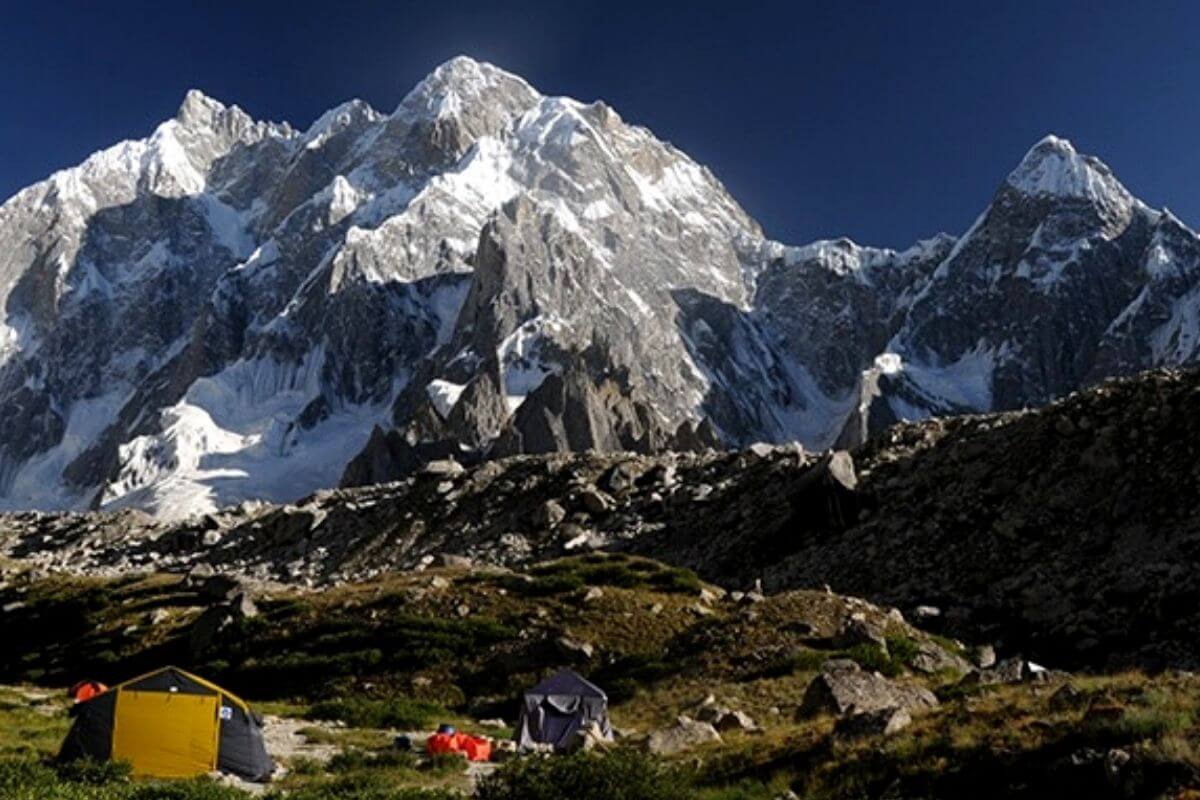
Malubiting West, commonly referred to simply as Malubiting, is one of the highest mountains in the Rakaposhi-Haramosh Range, a subrange of the Karakoram in Gilgit-Baltistan, Pakistan. With an elevation of about 7,458 meters (24,469 ft), it is the second highest peak in its range. Wikipedia+2caingram.info+2
Not only is the mountain immense in height, but its topography is rugged, faces steep, its glacier approaches challenging — making any expedition here a test of endurance, skill, and planning.
Name, Location & Surroundings
→ Name: Malubiting (also Malubiting West or simply “Malubiting Peak”) Wikipedia+2SummitPost+2
→ Elevation: ~ 7,458 m (24,469 ft) Wikipedia+2caingram.info+2
→ Prominence: ~ 2,193 meters Wikipedia+2SummitPost+2
→ Range: Rakaposhi-Haramosh Mountains, part of the Karakoram. Wikipedia+2Wikipedia+2
→ Location: Gilgit-Baltistan, Pakistan. Its western faces rise above the Phuparash River; on the east, the extensive Chogo Lungma Glacier originates from its slopes. It’s situated roughly 50 km east of Gilgit. Wikipedia+2caingram.info+2
→ Neighbouring Peaks: Haramosh Peak is nearby; also part of scenic glacier systems, valleys, and ridges around Chogo Lungma, Phuparash, etc. caingram.info+2Wikipedia+2
Climbing History
→ Early Attempts: There were multiple attempts before success — in 1955, 1959, 1968, 1969, 1970. Teams attempted various approaches but did not reach the summit. Wikipedia+2publications.americanalpineclub.org+2
→ First Ascent: The mountain was first successfully climbed on 23 August 1971 by an Austrian expedition led by Horst Schindlbacher (with team members including K. Pirker, H. Schell, H. Sturm, and others) via the Northeast Ridge, ascending the North Peak and bypassing (or skirting) the Central Peak on the way. Wikipedia+1
→ Subsequent Ascents: There has been at least one additional ascent (Swiss-German team in 1997), using the original route. Wikipedia+2SummitPost+2
Expedition Route & Logistics
→ Typical Route:
The classic route is via the Northeast Ridge, which was used on the first ascent. Approaches often involve glaciers — typically the Chogo Lungma Glacier and/or the Phuparash side. Wikipedia+2SummitPost+2
→ Base Camp Access:
Base Camp can be established after trekking through valleys to the glacier approaches. Access is usually via Phuparash or Chogo Lungma; roads/trails to these valleys require off-road jeep travel from Gilgit, then multi-day trekking, glacier travel to reach the glacier foot and BC.
→ Acclimatization & Camps:
Due to the altitude (7,458 m), expedition teams typically establish several camps above base camp. Acclimatization rotations are necessary. Weather windows are narrow. Late summit push requires high camps, fixed ropes on steep sections, possibly snow or ice walls.
→ Duration:
Expeditions generally require multiple weeks (often 3-5 weeks or more) including approach, establishing camps, summit push, and return. For example, operators offering guided expeditions may plan for ~ 30-40 days including all approach & contingency. (Note: specific itinerary varies by operator.)
→ Cost & Service Options:
Authorized operators provide “base camp” services or “full board” with support (porters, guides, cooks, etc.), fixed departures, gear assistance. Prices vary depending on services, group size, duration. For one such operator, rate starts from about USD 7,200 for Malubiting Peak Expedition.
Best Time to Climb & Weather
→ Climbing Season: Summer through early autumn (June to September) is generally best. In this period, snow is more stable, glacier conditions manageable, and daylight hours long enough.
→ Weather Challenges: The region suffers from microclimate issues: sudden storms, prolonged cloud cover, heavy precipitation/snow at times, glacier instability. These can delay or threaten camps & summit pushes. Early in expedition history, some teams got stuck at Base Camp for weeks due to continuous bad weather. Himalayan Club+2Mount Everest Foundation+2
Highlights & Scenic Appeal
→ Panoramic views of Karakoram giants, including Haramosh, Rakaposhi, and glaciers like Chogo Lungma.
→ Dramatic rise over local terrain: steep relief, massive ice fields, seracs, ridges.
→ Wilderness, remote valleys, rich alpine environment.
Challenges & Hazards
→ Glacier dangers: crevasses, icefall, unstable snow bridges.
→ Weather: sudden storms, high winds, snow accumulation.
→ Logistics: long approach, supply lines, limited rescue access.
→ Altitude: risk of altitude sickness, need for acclimatization.
→ Route complexity (rock, ice, mixed terrain), possibility of avalanches.
Environmental & Community Considerations
→ Supporting local communities: hiring local guides/porters, sourcing supplies locally.
→ Respect for environment: packing out waste, minimizing camp impact, respecting local flora & fauna.
→ Monitoring glacier conditions: climate change has impacts on ice mass, snow coverage, which can affect safety.
→ Cultural respect: the valleys around Malubiting are home to mountain villages with unique traditions.
FAQ
Q: What is the elevation of Malubiting West?
A: Approximately 7,458 meters (24,469 feet). Wikipedia+1
Q: When was it first climbed and by whom?
A: The first successful ascent was on 23 August 1971 by an Austrian team (H. Schindlbacher, K. Pirker, H. Schell, H. Sturm) via the Northeast Ridge. Wikipedia+1
Q: How many expeditions have summited since first ascent?
A: There has been at least one well-documented subsequent ascent (Swiss-German team in 1997) via the original route. There may be other unrecorded climbs. Wikipedia+1
Q: What is the standard route for Malubiting West?
A: The classic route is via the Northeast Ridge, which was used for the first ascent. Approaches are via glaciers (Phuparash, Chogo Lungma) to reach Base Camp, then higher camps up the ridge.
Q: When is the best time to attempt this expedition?
A: Best season is summer to early autumn (June to September) when weather is more stable and access is safer. Outside this window, snow, storms, and avalanche risk rise.
Q: How difficult is the climb? What skills are required?
A: Very difficult. Climbers must be experienced at high altitude, glacier travel, mixed snow/ice/rock climbing, and route finding. Good fitness, acclimatization experience, and ability to endure lengthy camps are essential.
Q: How do I get permits or permissions?
A: You will need climbing permits from the government of Gilgit-Baltistan (Pakistan), likely NOCs or clearance for valley access, possibly coordination with local administrations. Using a reputable operator helps with paperwork.
Q: What gear should I bring?
A: Full high-altitude mountaineering gear: tents, sleeping bags rated to −20°C or lower, crampons, ice axes, harnesses, ropes, technical gear for mixed climbing, navigation (GPS, maps), communication (satellite phone or radio), safety equipment.
Q: How much does a typical Malubiting West expedition cost?
A: Costs vary widely based on operator, support level, group size, and services. One tour operator lists a price starting from USD 7,200 for their guided expedition.
Q: What are the biggest risks during the expedition?
A: Glacier hazards (crevasses, icefall), sudden storms and heavy snow, altitude sickness, route hazards (rock/ice), possibility of delays due to weather, limited rescue options in remote terrain.
Sample Expedition Itinerary
| Day | Activity |
|---|---|
| Day 1 | Arrive in Islamabad → fly/drive to Gilgit; gear prep & permits |
| Day 2-3 | Travel to Phuparash or Chogo Lungma Valley, begin trek to approach camps |
| Day 4-6 | Establish Base Camp; acclimatization hikes and gear checks |
| Day 7-10 | Set up intermediate camps (Camp I, Camp II, etc.), acclimatization rotations |
| Day ~11-13 | Summit push via Northeast Ridge; high camps and overnight camps |
| Day ~14-16 | Descent to Base Camp, rest & recovery |
| Day ~17-19 | Trek back to access road; return to Gilgit/Islamabad |
(Times may vary depending on weather, group pace, route, etc.)
TERMS & CONDITION:Chogholingsa Trek &Tours promulgates its terms and conditions for any kind of trip, trekking, mountaineering, hiking, rafting, wild safaris and other services being operated so far by the company. The terms and conditions set forth will bring forward its limitations before any interested visitor advances for the programs alluded. What should our clients do for reservation of any kind of services provided by the company? 40% of payment in advance should be made up 1 month earlier or as soon as the trip is confirmed, since it is a proof that you are sure to attempt the trip. It should be done as alluded so that the company can manage all the necessary documents, permissions and required field staffs. The full settlement of the payment should be cleared before the client proceeds for the trip or any kind of service at the arrival in Pakistan. The advance payment is not refundable in case of overturning the trip in any condition on behalf of the client. The advance payment is only refundable if the holding company shows any technical impediments regarding the trip. No refund is made for 40% deposit amount in case of delay arrival, no show or cancellation of trip for any other else reason. For any consideration regarding the terms alluded, a bilateral negotiation can be attempted between the hosting company and the client The advance payment can be directly deposited to our bank account through any bank in the world. 1: REFUND: No refund will be made for 50% deposit amount in case of cancellation of trip for any other else reason. Having paid full amount of any trip, you’re entitled to incur refund in case if you want to cancel your trip. Still, cancellation charge is invoiced to you. Written notification of your cancellation should be made to cancel any trip. Nevertheless, you’re imposed cancellation charge as advised below: – 2: SUPPLEMENT CHARGE: On our holidays tour / trek packages, rooms or tents are provided in twin sharing basis. Thus, single room supplement charge will be imposed to client who does not have another tour participant to share room / tent with. 3: INCOMPLETE TOUR: No refund will be made to clients who drop out from the journey regardless of whatever portions remain unused in the itinerary. 4: CLIENTS’ RESPONSIBLE: A tour / trek guide who represents Chogholingsa trek & Tours deserves all authority during your tours. If you commit any unlawful act, you are compelled to leave the tour. No refund will be made in such case. 5: IMPACT ON YOUR JOURNEY: We put our every effort to ensure comfortable traveling of yours,but it is must to understand that what you might be accustomed to in the western affluent countries, the Asian countries can’t afford such facilities. Weather is another factor that directly impact on your journey. Hence, patience in mind, enthusiasm and proper preparation before head is must to venture into journey. 6: TRAVEL INSURANCE: You must purchase comprehensive travel insurance package against medical, natural calamity, helicopter evacuation, personal accident, trip cancellation etc. This is suggested to all our esteemed clients. 7: TOUR AMENDMENT: 8: PAPERS AND DOCUMENTS: All necessary documents should be presented in sequence for example to issue visa, necessary permits etc. We’re not accountable in case of any trip formality not completed in time before the trip departs on the absent of essential papers and documents. 9: RISK AND RESPONSIBILITY: Your safety and enjoyment is our prime concern. We therefore carry out our responsibility honestly & sincerely to ensure your holiday trouble–free as well as you have desired. Nevertheless, unless stated otherwise, trip may be change under uncertain and inherent circumstances such as land-slides, road blockage, flood, snow political unrest, cancellation of flight, delay arrival, sickness or accidents etc. Any extra cost incurring there is your personal responsibility and should be borne on the spot. 10: FLIGHT DELAY / CANCELLATION: There is virtually possibility of flight delay or postponement for notorious weather in Karakoram & Himalayan Mountain regions of Pakistan which could be happened, especially during off season, you’re highly advised to reserve extra days to prepare with some delays and avoid frustrating consequence. In case of flight cancellation pre-tour/post-tour, you need to meet your accommodation and food costs yourself. Chogholingsa trek & Tours puts every effort to ensure your comfortable traveling, but it is must to understand that what you might be accustomed to in the other affluent countries, the Asian countries can’t afford such facilities. Weather is another factor that directly impacts your journey. Hence, patience in mind, enthusiasm and proper preparation before beginning is must to venture into journey. |
→01 RESERVATIONS / PAYMENTS: A non-refundable deposit of $300 or 15% of the tour is required in order to make a reservation with the company. Total balance is due 3 weeks prior to departure. When price once fixed then any extra expenses will not be charged to the client |
Account Details |
Bank Name: | Habib Bank Pvt.LTD. |
Account Title: | Chogholingsa |
IBAN NO: | PK73 HABB 0004767901352403 |
swift code | HABBPKKA Or HABBPKKA476 |
Branch Code | 0476 |
Branch name: | Main Bazar Branch Skardu |
g elit. Ut elit tellus, luctus nec ullamcorper mattis, pulvinar dapibus leo.
OUR SERVICES
Included
01:- Airport pick and drop
02:- Accommodation bed & B.fast, twin bedroom in Islamabad and other cities standard air-condition rooms.
03:- Flight Ticket or transportation from Islamabad/ Skardu/ Gilgit/chitral or from these cities to Islamabad
04:- Skardu/Gilgit/Hunza Hotel (bed & breakfast)
05:- Two nights in Chilas/ Besham hotel (bed & breakfast) incase of flight cancellation.
06:- Jeeps Skardu/Askoli/ Hushe/ Skardu/shimshal/Chitral/Kalash or vice virsa.
07:- Wages, insurance, food equipment of cook
08:- Wages, insurance, food equipment of Assistant cook,
09:- Wages, insurance, food of Porter Sirdar
10:- Porter Payment, Low altitude porters.
11:- Baggage,75 kg (going time) and 50 kgs (on return) for expedition 45 days or more and 25 kg for trekking group & trekking peak
12:- Full board camp food during trek & at base camp.
13:- Mess tent, Kitchen tent, store tent, table , chairs and kitchen equipment
14:- Reconfirmation of international flight tickets.
15:- Camping fees, road taxes & bridge crossing of expedition members & Porters.
16:- Porters Equipments.
17:- Assistance in obtaining climbing permit and other documentations
18:- Briefing and debriefing in the Ministry of tourism
19:- CKNP fee: US $ 150/per member
20:- 1000 US$ guarantee pollution fee.
21:- 200 US$ environmental protection fund.
22:- Fuel, Tarpaulin, and Stove for porters.
23:- Kerosene Oil for porter and Members
24:- Toilet tent and shower tent
25:- Members will have individual D-4 in Base camp tents, and mattress for expeditions more than one month
26:- LO insurance or guide transport and hotel/ equipment and TA/DA.
27:- Royalty fee and additional member fee
Not Included
1:- Sleeping bags, rucksacks and personal clothing.
02:- Medication, ground evacuation and helicopter rescue (US$15,000) of any kind.
03:- Room services, laundry charges, beverages and items of personal nature. Phone /communication
04:- Climbing food beyond base camp, equipment, high altitude Porters wages bills.
05:- Insurance or liability of any members.
06:- Tip to staff
07:- Custom clearing and forwarding agent’s charge.
08:- Food & drinks during stay in hotel (City)
09:- Transport to other cities or places out of itinerary
10:- Custom clearing and forwarding agent’s charge.
11:- Extra baggage charges during international or domestic flight
12:- Insurance or liability of any members.